
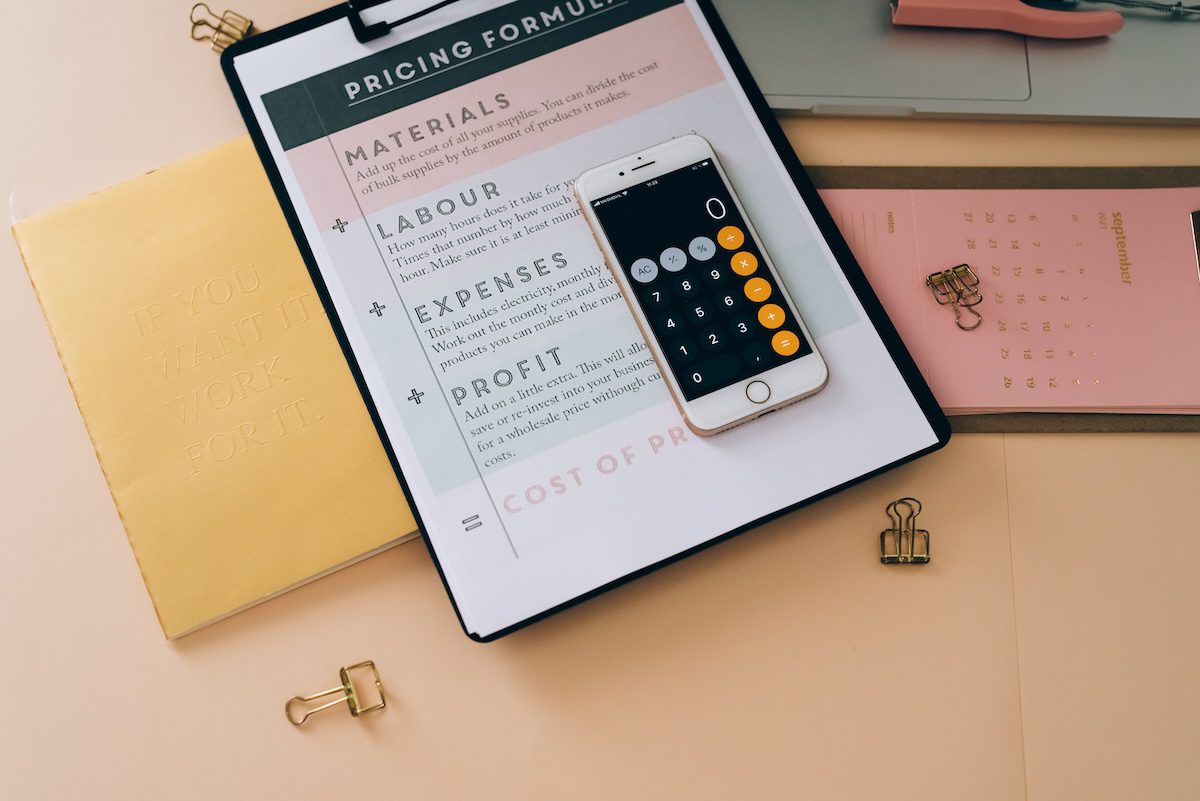
How to price your main offer (without undercharging)
Most of us pick a price by looking at what everyone else charges and then knocking a bit off to be safe. Here's a better way: work out your floor, add your value on top, and charge a price your business can actually live on.
Undercharging rarely feels like a decision. It creeps in: a price set when you were brand new and never changed, a discount for a friend that became your standard rate, or an extra half-hour added to every job "because it's easier than asking".
The trouble is that a price that's too low doesn't only cost you money. It costs you time you'd have spent marketing, it fills your diary with work that wears you out, and it quietly tells customers your work is worth less than it is. So this guide skips the guessing. By the end you'll have a minimum price you can defend, a sense of where above it you should sit, and the words to say it out loud.
Why we undercharge
Before the numbers, it helps to name what's actually going on. In nearly every conversation about pricing in our community, it comes down to one of these:
- Pricing from fear, not from maths. We choose the number we think nobody could say no to, rather than the number the business needs.
- Charging for the hour, not the result. If something takes you 40 minutes because you've done it 400 times, the customer is paying for those 400 times, not the 40 minutes.
- Forgetting the hidden hours. The admin, the emails, the revisions, the travel and the "quick question" calls are all part of the job, even if they never show up on the invoice.
- Copying the wrong competitors. Some of the businesses you're comparing yourself with are hobbies, or are subsidised by another income, or are just as underpriced as you are.
- Treating a low price as kindness. It's not kind to anyone if the business has to close.
Find your floor price
Your floor is the lowest price you can charge without losing money or working for less than you need. It isn't your price, it's the number you never go below. You need four things to work it out:
- What you need to take home each month. Be honest, not modest. This is your wage.
- A tax buffer. Many sole traders set aside 20–30% for Income Tax and National Insurance. Check your own position with an accountant or HMRC.
- Your monthly business costs. Software, hosting, materials, insurance, phone, subscriptions, fees and advertising.
- Your sellable hours. This is the number of hours a week you can actually spend on paid work. For most solo founders it's about half their working week, because the other half goes on marketing, admin and running the business.
A worked example
| Take-home she needs each month | £2,500 |
| Plus a 25% tax buffer (£2,500 ÷ 0.75) | £3,333 |
| Plus business costs | £300 |
| Revenue the business must bring in | £3,633 / month |
| Sellable hours (15 a week × 4.33 weeks) | 65 hours |
| Hourly floor | £56 / hour |
| Her logo package takes 8 hours, start to finish | × 8 |
| Floor price for the package | £448 |
Sarah had been charging £250. At that price she would need about 15 logo clients a month just to pay herself, and she only has the hours to do eight.
That last line is the moment most people's stomachs drop. It's also the most useful thing you'll learn about your business this year. Try your own numbers below.
Floor price calculator
Pick your currency, change any figure and the results update straight away. Nothing is saved or sent anywhere.
This is a guide, not financial advice. Your floor is the minimum, not your price.
Add your value on top
The floor covers you. Your price should reflect what the result is worth to the person buying it. Ask yourself three questions:
- What does this change for them? More sales, saved time, less stress, a launch that actually happens, a home they love walking into. Put a rough figure on it where you can.
- What would it cost them to get this another way? Hiring an agency, doing it themselves over six weekends, or not doing it at all.
- What makes yours different? Speed, specialism, your eye, your process, the fact you've done it for 300 people just like them.
If a new website brings a client £10,000 of work over the next year, a £1,500 price is good value, not greedy. As a rule of thumb, many service businesses find their sweet spot somewhere between 1.5 and 3 times their floor. Sarah's £448 floor suggests a logo package somewhere between roughly £670 and £1,340, depending on how established and specialised she is.
Your floor is what you need. Your price is what it's worth. Never let the second fall below the first.
Sense-check the market
Now, and only now, look at what others charge. Research is there to check your price, not to set it for you. Pick five businesses that serve the same customer at the same level as you, then note:
- Their price, and exactly what's included for it
- Whether they look full (waitlists, "booking from March", sold-out notices)
- How they present it, because a premium price with a premium presentation sells far more easily than a premium price on a cluttered page
If you come out in the bottom third, that's a sign you're underpriced, not that you're competitive. If you're at the top, make sure your page, your proof and your process show why.
Signs you're undercharging
- Nearly everyone says yes straight away, with no hesitation at all
- You're busy but your bank balance doesn't reflect it
- You feel a flash of resentment when a client asks for something small
- You can't afford to outsource, invest or take a week off
- Your best clients tell you, "honestly, you should charge more"
- You haven't reviewed your prices in over a year, while your costs have gone up
If three or more of these sound familiar, your price is almost certainly too low. A few people saying "that's a bit out of my budget" is a healthy sign. It means you've found the edge of your market rather than sitting well below it.
How to raise your price
You don't need a big announcement. You need a date and a sentence.
For new customers
Change it today. New people have never seen your old price, so there's nothing to explain. Update your website, your price list and your proposals, then say the new number without apologising.
For existing customers
Give notice of 30 days or more, say it once, and keep it short:
When someone pushes back
Don't drop the price. Change the scope instead:
That keeps your price intact and gives them a real choice. Offering a discount teaches people that your first number was never your real number.
Your pricing checklist
- Run your numbers through the calculator and write down your floor price.
- List the result your main offer gives a customer, with a rough £ value if you can.
- Choose a price between 1.5 and 3 times your floor, and say it out loud five times.
- Check five comparable businesses, and adjust your presentation rather than your price.
- Pick a date for new pricing and write the one-line notice for existing customers.
- Share your new price in FEHQ, and we'll hold you to it.
Bring your numbers to the HQ
Inside Female Entrepreneurs HQ you'll find women who'll look at your price with you, tell you honestly when it's too low, and cheer when you finally raise it.